What is leadership?
Mar 12, 2026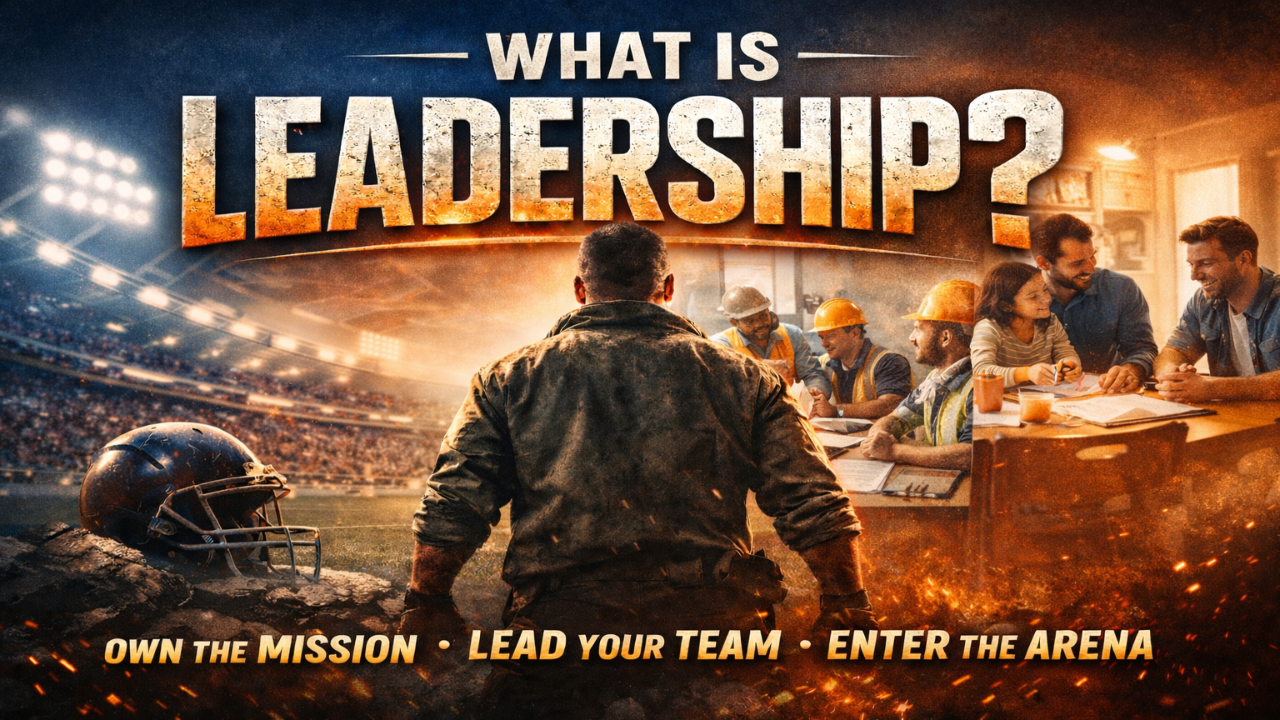
Mayner Leadership / 9 min Read
By Desi Mayner
Key Takeaways
-
Leadership is the skill of getting a group of people to happily work together to accomplish a common goal.
-
Leadership is learned, practiced, and improved through daily action and disciplined habits.
-
Great leaders lead with Absolute Accountability—owning the mission, the problems, and the outcomes.
-
Strong leadership requires clear communication, disciplined execution, and empowered teams.
-
The best leaders multiply themselves by developing more leaders inside the organization.
Leadership is one of the most powerful forces in the world.
When leadership is strong, teams move faster, problems get solved, and people feel proud of the work they’re doing.
When leadership is weak, confusion spreads, standards drop, and people disengage.
Every business owner eventually discovers the same truth:
Leadership is the root of ALL problems, and it’s also the solution to nearly every challenge.
The quality of leadership determines the quality of results.
At Mayner Leadership, we define leadership very simply:
Leadership is the skill of getting a group of people to happily work together to accomplish a common goal.
That goal might be winning a football game, completing a military mission, growing a business, raising a family, or serving a church community. The environment may change—but the principles of leadership remain the same.
Leadership is not a personality trait.
Leadership is a macro skill made up of dozens of smaller skills—communication, accountability, discipline, decision-making, emotional control, and clarity.
And like any skill, it can be learned.
But leadership doesn’t improve through theory alone.
Leadership improves through daily reps.
It shows up in real situations:
-
The difficult conversation with an employee
-
The decision when the team is stuck
-
The moment expectations must be clarified
-
The responsibility of setting the tone for the organization
Leadership isn’t abstract.
It’s operational.
It’s answering the question:
What does leadership look like on Tuesday at 2:00 PM?
Traits of a Great Leader
Great leaders are not defined by titles.
They are defined by character, discipline and behavior.
Leadership requires a foundation that people can trust and respect. Without that foundation, teams eventually lose confidence in the leader and the mission.
The strongest leaders consistently demonstrate several core qualities.
Unimpeachable Character
Great leadership starts with character.
A leader must be the type of person others are proud to associate with personally and professionally.
When your name comes up in conversation, people should immediately think of integrity, honesty and consistency.
Character builds credibility.
And credibility builds influence.
Without strong character, leadership eventually collapses.
Absolute Accountability
Great leaders take responsibility for everything that affects the mission.
That means owning:
-
The results
-
The problems
-
The breakdowns
-
The improvements
Leaders must be accountable to:
-
Themselves
-
The Mission
-
The Team
They lead up, down and across the organization.
Strong leaders don’t look for someone to blame.
They take ownership and move the team forward.
Sincere Candor
Nothing great is built without honest feedback.
Great leaders practice bold honesty delivered with respect. They speak truthfully about problems, performance and opportunities for improvement.
This candor must exist internally with the team and externally with partners and clients.
When honesty disappears, confusion and resentment replace it.
But when candor is present, trust grows and teams improve quickly.
Elite Communication
Communication is the most important skill in leadership.
Great leaders deliver simple, clear, concise and honest information as consistently as necessary to ensure understanding.
They make sure people know:
-
What the mission is
-
What the expectations are
-
What success looks like
-
What needs to happen next
They also encourage open dialogue, because strong communication builds strong relationships and strong relationships build strong teams.
Competitive Greatness
Great leaders perform when the pressure is highest.
They are at their best when their best is needed.
They enjoy challenges, embrace responsibility and rise to the moment when the mission is on the line.
Competitive greatness means you don’t shrink from the moment.
You step forward.
The Offensive Lineman Mentality
A great leader is a lot like a great offensive lineman in football.
When the team scores a touchdown and everyone is celebrating in the end zone, the offensive linemen usually aren’t the ones getting the spotlight.
Their face is buried in the dirt.
They’re in the trenches doing the hard work that made the play possible.
That’s leadership.
Great leaders aren’t chasing recognition.
They are doing the difficult work behind the scenes so the team can succeed and celebrate together.
The scoreboard may highlight the quarterback or the receiver.
But anyone who understands football knows who made the play possible.
The same is true in leadership.
Real leaders create the conditions for others to succeed.
And when the team wins, that’s the reward.
The Laws and Mindsets of Leadership
Leadership becomes powerful when it is organized into clear principles that can be applied every day.
At Mayner Leadership, leadership is operationalized through a set of laws that guide how leaders think, communicate, and execute.
These principles form the foundation of the Absolute Accountability Leadership Framework.
There are three categories of leadership laws.
People Laws
These laws govern how leaders build and lead teams.
The goal is unity, clarity, and shared ownership.
The three People Laws are:
Unite & Support
Strong leaders build unified teams. Silos disappear and relationships strengthen because everyone understands they win or lose together.
Inform, Update & Clarify
People cannot execute what they do not understand. Leaders communicate expectations clearly and consistently so confusion never becomes chaos.
Distribute & Empower
Strong organizations create leaders at every level. Great leaders teach, train, equip and empower others to lead.
Mission Laws
These laws govern how leaders guide the mission.
They ensure the organization stays focused and moving forward.
The three Mission Laws are:
Keep It Simple
Complexity kills execution. Leaders simplify the mission and make the plan easy to understand.
Prioritize & Execute
Great leaders detach from chaos, identify the most important objective, and guide the team through the correct sequence.
First.
Then.
Next.
Innovate & Adapt
The mission stays the same, but strategy must evolve. Strong leaders continuously improve and adapt ahead of the competition.
Self Laws (Leadership Mindsets)
Leadership begins internally.
The strongest leaders develop disciplined mindsets that guide how they think and behave.
The six Self Laws are:
Humility – checking ego and remaining coachable.
Awareness – understanding people and situations clearly.
Discipline – modeling the standards the team needs.
Conviction – believing deeply in the mission.
Initiative – solving problems and creating momentum.
Balance – remaining composed and grounded under pressure.
Leadership is an internal game before it becomes an external one.
The Paradoxes of Leadership
Leadership is not simple.
It often requires balancing opposing forces.
Lean too far in one direction and you lose the team.
Lean too far in the other and you lose the mission.
Great leaders learn to walk the line.
At Mayner Leadership, we teach three categories of leadership paradoxes.
People Paradoxes
Leaders must balance tensions involving the team.
Examples include:
-
Team vs Mission
-
Accountability vs Empowerment
-
Firm vs Forceful
-
Coach vs Fire
These paradoxes require wisdom and emotional intelligence.
Mission Paradoxes
Leaders must also balance tensions in execution.
Examples include:
-
Hard vs Smart
-
Aggressive vs Reckless
-
Structured vs Rigid
-
Accountability vs Dependency
These paradoxes keep teams moving forward without becoming chaotic or stagnant.
Self Paradoxes
Leadership also requires internal balance.
Examples include:
-
Lead vs Follow
-
Plan vs Complicate
-
Humble vs Passive
-
Focused vs Fixated
These paradoxes help leaders stay grounded and effective under pressure.
Together, these laws, mindsets, and paradoxes form a practical leadership system.
This is the framework behind How to Lead Anything, Anyone, Anywhere.
And it’s the system Coach Desi and Mayner Leadership use to teach, train, equip and empower owners, operators, managers and leaders at every level of small business.
Leadership Myths and Myth Busters
Leadership is surrounded by many myths.
Let’s clear up a few.
Myth: Leadership means controlling people.
Truth:
Leadership is not control. It’s guiding people to perform at a higher level.
Myth: Leaders are born.
Truth:
Leadership is a skill developed through practice and experience.
Myth: Only dominant personalities can lead.
Truth:
Leadership exists across every personality type.
Character and discipline matter more than personality style.
Myth: Leadership is about popularity and power.
Truth:
Leadership is about responsibility.
Great leaders serve the mission and the team.
Myth: You need a title to lead.
Truth:
Titles do not create leadership.
Ownership does.
The Picture of Leadership
Imagine a football coach standing on the sideline during a championship game.
He’s not the one throwing passes or making tackles.
But every play and every adjustment flows through his leadership.
He builds the team.
He trains the players.
He calls the plays.
And when the game becomes chaotic, he brings clarity.
That’s leadership.
Not control.
Responsibility.
Not ego.
Service to the mission and the team.
Great leaders create environments where people believe in the mission, trust their teammates and execute together.
That’s how teams accomplish things no individual could accomplish alone.
The Man in the Arena
Leadership is not for spectators.
It’s for people willing to step into the arena.
Leadership requires courage.
It requires humility.
It requires taking responsibility when things go wrong and continuing to lead when the pressure is high.
Theodore Roosevelt captured the heart of leadership perfectly when he described “the man in the arena.”
Not the critic.
Not the person standing safely on the sidelines pointing out mistakes.
But the one whose face is marred by dust and sweat and blood.
The one striving.
The one struggling.
The one daring greatly.
That is leadership.
Leadership is stepping into the arena when things are difficult.
Taking responsibility for the mission.nop
Leading the team through adversity.
Falling short sometimes—but rising again and continuing forward.
Because in the end, the credit belongs to the one who is actually in the arena.
And that is the leader your team needs.
Get the Newsletter
Want Tactical Business and Leadership Tips sent to your inbox every week? We've got a newsletter just for you
We hate SPAM. We will never sell your information, for any reason.