How to Scale a Business Without Breaking It
Aug 28, 2026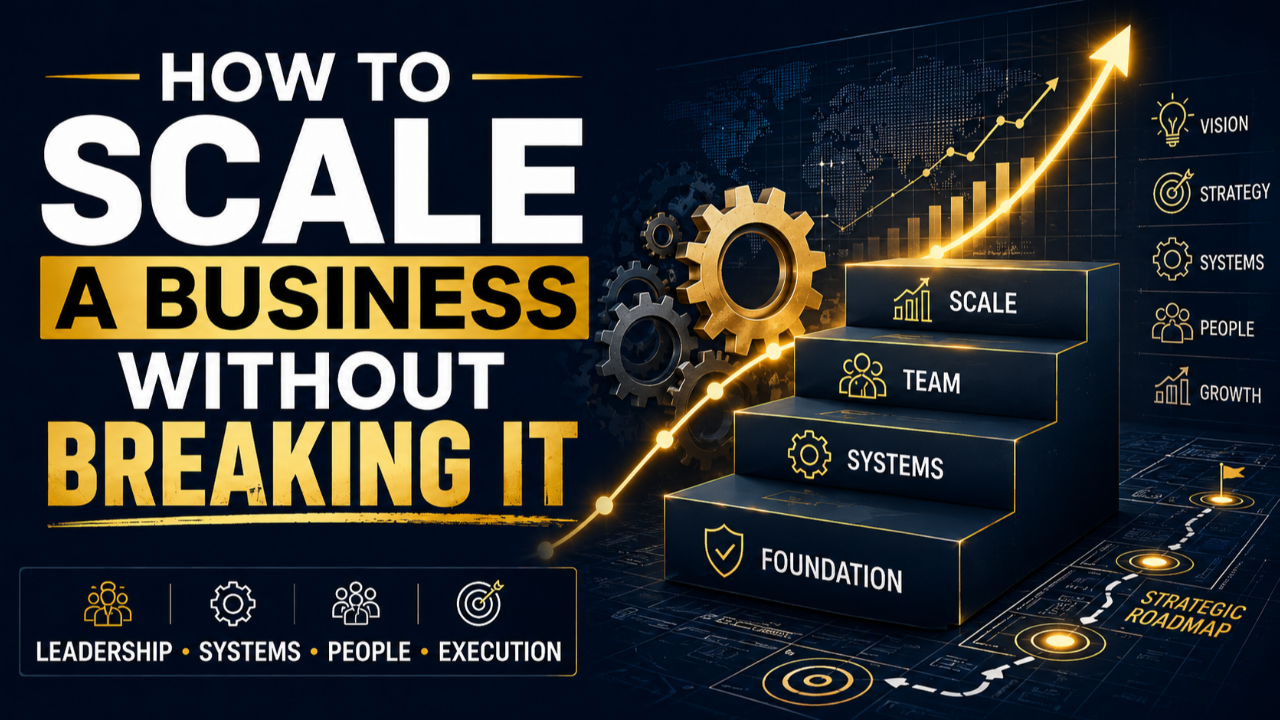
How to Scale a Business Without Breaking It
9 min Read by Desi Mayner
In This Article
-
What Does Scaling a Business Mean?
-
Are You Ready to Scale Your Business?
-
What Scaling Your Business Can Mean for You
-
The Three Essentials to Scaling Your Business
-
What’s Next?
Key Takeaways
-
Scaling means increasing revenue and capacity without your expenses, workload and chaos increasing at the same rate.
-
Before you scale, you need the right people, processes, systems and leadership structure in place.
-
Sustainable growth requires more than sales. It requires clear direction, role clarity, leadership development and consistent execution.
-
To scale successfully, you need a simple strategic plan, leaders who can carry responsibility, and a united team committed to the mission.
-
Growth without leadership creates bigger problems. Growth with Absolute Accountability creates greater opportunities.
Building a successful small business is a major accomplishment.
You have taken the risks, solved the problems, served the customers, made payroll, carried the stress and done whatever was necessary to keep the business moving forward.
But business success creates a new challenge.
The systems, habits and leadership style that helped you reach your current level may not be strong enough to take you to the next one.
More customers create more communication.
More employees create more leadership challenges.
More revenue creates more financial responsibility.
More opportunity creates more complexity.
That is why growing a business is not simply about getting more work. It is about developing the people, leadership and structure necessary to handle more work without allowing the business to become more chaotic, inefficient or dependent on you.
The goal is not simply to build a bigger business.
The goal is to build a stronger business.
That is what scaling is all about.
What Does Scaling a Business Mean?
Scaling means increasing revenue, production and impact without your expenses and workload increasing at the same rate.
There is an important difference between growing and scaling.
Growth often means adding more resources to produce more revenue. You hire more employees, buy more equipment, add another vehicle, increase advertising or open another location.
Revenue may increase, but so do your expenses.
Scaling means your business becomes more productive, profitable and efficient as it grows.
You are not simply doing more.
You are getting better at how the work gets done.
A growing company may add ten new customers and immediately need to hire another employee to handle the workload.
A scaling company may add ten new customers because it improved its processes, trained its people, clarified responsibilities and eliminated unnecessary work.
That is the difference.
Scaling requires you to apply the Law of Keep It Simple.
Complexity kills execution. As the business grows, your mission, expectations, communication and processes must become clearer—not more complicated.
Without the proper structure, growth often creates predictable problems:
-
New opportunities are turned away because the company cannot handle the work.
-
The owner becomes the answer to every question.
-
Leaders are overwhelmed and stretched too thin.
-
Employees become confused about responsibilities.
-
Communication begins to break down.
-
Customer service becomes inconsistent.
-
Mistakes, rework and frustration increase.
-
The team begins to burn out.
Growth without leadership is not sustainable.
Scaling means building a company that can accept more opportunities, serve more customers and produce better results without breaking the people or the business.
A Cautionary Tale: When Growth Outpaces Leadership
Groupon is a well-known example of what can happen when growth moves faster than leadership, systems and execution.
The company launched in 2008 with a simple idea: Use group purchasing power to offer customers large discounts from local businesses.
Customers received attractive deals. Local businesses gained exposure and new customers. Groupon received a portion of each purchase.
The concept grew extremely quickly.
Within a few years, Groupon became one of the fastest-growing companies in the country. The business expanded into new markets, added employees and gained millions of customers.
But its growth moved faster than its ability to manage that growth.
The systems, processes, leadership structure and business model were not prepared to support the company’s expansion. Expenses increased, problems multiplied and the company struggled to maintain profitability.
The lesson is simple:
Growing fast does not automatically mean you are growing well.
This is where the Leadership Paradox of Aggressive vs. Reckless becomes critical.
You must attack opportunities and move with urgency, but you cannot charge forward without understanding the risks, capacity and consequences.
Bold action matters.
Controlled execution matters more.
The goal is not to avoid growth. The goal is to make sure your people, processes and leadership can support it.
Are You Ready to Scale Your Business?
Before you push for more revenue, customers, locations or employees, you need to honestly evaluate whether your business is prepared to handle them.
Scaling is not only a financial decision.
You need the right systems, processes, people and leadership structure in place.
Ask yourself:
-
Can the business operate effectively without me being involved in every decision?
-
Do our team members understand their roles and responsibilities?
-
Do we have consistent processes for completing important work?
-
Do our leaders know how to lead people and produce results?
-
Are our meetings consistent, reliable and productive?
-
Can we measure whether the company is winning or losing?
-
Does the team understand the mission, priorities and expectations?
-
Are people held accountable for following through?
-
Can our current structure handle additional customers and employees?
If most of your answers are no, your first priority should not be growing faster.
Your first priority should be strengthening the foundation.
Stage One: The Business Depends on You
Many owners begin with a business that depends heavily on their personal effort, knowledge and decision-making.
The owner sells the work, solves the problems, approves the purchases, answers employee questions and handles the emergencies.
This may work when the company is small, but it creates a ceiling.
You cannot scale a business when everything must flow through one person.
To move beyond this stage, you must improve your ability to:
-
Manage your time.
-
Understand your finances.
-
Hire the right people.
-
Clarify roles and responsibilities.
-
Delegate outcomes instead of individual tasks.
-
Develop repeatable processes.
-
Hold people accountable.
This requires the Law of Distribute & Empower.
Your team cannot grow if you continue to hoard control.
You must teach, train, equip, empower and sustain people so they can carry responsibility without constantly waiting for you.
Delegation is not abandonment.
Empowerment is not giving up control.
It is giving people the clarity, authority, resources and accountability necessary to produce the expected result.
Stage Two: The Team Needs Direction
Once you begin building a team, another challenge appears.
People may be working hard, but they may not be working together.
Departments become isolated.
Priorities compete.
Employees receive mixed messages.
Everyone becomes busy, but the company does not consistently move forward.
This is where the Laws of Unite & Support and Inform, Update & Clarify become essential.
Your team must understand:
-
The mission of the company.
-
The core values.
-
The most important goals.
-
Their individual role.
-
How their work supports the bigger mission.
-
What success looks like.
-
Who is responsible for what.
-
What must happen first, then and next.
Remember:
No understanding means no execution.
You may understand the vision perfectly, but that does not mean your team does.
Leaders must communicate clearly, consistently and proactively. They must inform people before confusion begins, update them as conditions change, and clarify expectations when execution becomes inconsistent.
You are ready to begin scaling when your business no longer depends entirely on you, your leaders can carry meaningful responsibility, and your team is aligned around a common objective.
What Scaling Your Business Can Mean for You
Scaling the right way can increase profit, but the greatest reward is not always financial.
Scaling can completely change the way you experience your business.
You Are No Longer the Only Decision-Maker
You have leaders who can evaluate situations, make decisions and solve problems without bringing every issue to you.
They understand the mission, values, expectations and priorities well enough to act with confidence.
This allows you to lead up, down and across the chain of command instead of becoming trapped at the center of every decision.
You Begin Leading Leaders
Instead of managing every employee and monitoring every task, you develop leaders who can guide their own teams.
Your job begins to shift from doing the work to developing the people responsible for the work.
You teach, train, equip and empower leaders to:
-
Communicate expectations.
-
Delegate responsibilities.
-
Coach team members.
-
Hold people accountable.
-
Solve problems.
-
Protect the mission.
-
Produce results through others.
That is one of the biggest transitions an owner must make.
You are no longer trying to personally control every result.
You are building leaders who can create results.
Your Team Works Together
Scaling becomes possible when the organization operates as one team rather than a collection of individuals and departments.
Teamwork always wins.
Relationships are critical.
Silos must be broken down.
When the team fails, everyone fails.
The enemy wears a different color.
Your employees are not competing against one another. They are competing against confusion, inefficiency, poor communication, inconsistency and the competition outside the company.
A united team communicates better, solves problems faster and supports one another when pressure increases.
You Have More Time to Lead Strategically
When capable people and reliable systems are in place, you gain the ability to step back from the daily chaos and focus on the future.
You can spend more time:
-
Developing leaders.
-
Studying the numbers.
-
Evaluating opportunities.
-
Strengthening the culture.
-
Improving processes.
-
Building strategic partnerships.
-
Planning future growth.
-
Protecting the mission.
-
Identifying problems before they become emergencies.
This requires the mindset of Awareness.
Leaders must see what others miss.
You must detach from the emotion and urgency of the moment long enough to understand what is actually happening inside the business.
You cannot lead strategically when you are constantly reacting tactically.
The Three Essentials to Scaling Your Business
Scaling requires three essential elements:
-
A simple plan for growth.
-
Leaders who can move the plan forward.
-
A committed team that can execute the plan.
Before pushing for more, honestly evaluate whether you have all three.
1. A Simple Plan for Growth
Scaling does not happen by accident.
It requires a clear plan that defines where the business is going, how it will get there and who is responsible for each step.
Your growth plan should identify:
-
The mission.
-
The core values.
-
The critical actions.
-
The goals.
-
The objectives.
-
The strategies.
-
The action items.
-
The responsible person.
-
The deadline.
-
The measurements of success.
This is where the Law of Prioritize & Execute becomes critical.
You cannot fix everything, improve everything and pursue every opportunity at once.
You must detach, identify the highest priority and guide the team through the proper sequence:
First. Then. Next.
A strong plan is strategic and simple.
It should not become a massive binder filled with ideas that nobody reads or executes.
This is the paradox of Plan vs. Complicate.
You need enough planning to create clarity, but not so much planning that the company becomes slow, confused or paralyzed.
A plan should make execution easier.
Every important objective should have:
-
A clear outcome.
-
A responsible owner.
-
A deadline.
-
A measurement.
-
A next action.
Without these elements, you do not have a plan.
You have a list of good intentions.
2. Leaders Who Move the Plan Forward
You cannot scale a company through the effort of the owner alone.
You need leaders who believe in the mission, understand the plan and accept responsibility for producing results.
Bring your leaders into the planning process.
Give them the opportunity to identify problems, contribute ideas, challenge assumptions and help develop the strategy.
People are more likely to take ownership of a plan when they have helped create it.
But participation does not eliminate accountability.
Once the decision is made, the leadership team must unite and support the plan.
This requires the balance of Absolute Accountability vs. Empowerment.
As the owner or top leader, you remain accountable for the outcome.
But you cannot personally execute every strategy, solve every problem or manage every employee.
You are responsible for everything, but you cannot do everything.
That means your leaders need clear authority, clearly defined outcomes and consistent accountability.
Use your meeting rhythm to keep the plan alive.
Weekly leadership meetings should be used to:
-
Review important numbers.
-
Measure progress.
-
Identify obstacles.
-
Clarify priorities.
-
Assign responsibility.
-
Make decisions.
-
Adjust the plan.
-
Follow up on commitments.
Individual one-on-one meetings should be used to coach leaders, address concerns, develop skills and maintain alignment.
Plans do not fail because they were written poorly.
They usually fail because leaders stop communicating, measuring and following up.
3. A Committed Team to Execute the Plan
Leaders create direction, but the team creates execution.
Every team member should understand the mission, the priorities and the part they play in producing the result.
Do not assume people understand simply because something was announced once.
Important messages must be consistently repeated, reinforced and clarified.
As the business grows, communication must become more intentional.
Your team should know:
-
What are we trying to accomplish?
-
Why does it matter?
-
What is my responsibility?
-
What does winning look like?
-
What should I do first?
-
Who should I communicate with?
-
When is the work due?
-
How will my performance be measured?
Clarity creates confidence.
Confidence creates action.
Action creates results.
Once expectations are clear, you must fight for accountability.
Absolute Accountability means every person commits, owns and accepts responsibility for everything within their world that affects the mission.
That includes wins, losses, problems and solutions.
Each person must remain accountable to:
-
Themselves.
-
The mission.
-
The team.
Accountability should not create dependency.
This is the paradox of Accountability vs. Dependent.
Leaders must hold people accountable without training them to wait for permission, answers or approval every time a problem appears.
The goal is not to create followers who depend on the leader.
The goal is to create capable people who think, communicate, solve problems and lead.
What’s Next: Are You Ready to Scale?
Before you pursue more revenue, customers, employees or locations, pause and evaluate the strength of your foundation.
Ask yourself:
-
Is our mission clear?
-
Are our priorities simple?
-
Are our roles clearly defined?
-
Are our leaders prepared?
-
Are our processes documented?
-
Are our meetings effective?
-
Are our numbers being measured?
-
Are responsibilities assigned?
-
Are people following through?
-
Can the business operate without everything depending on me?
Scaling is not simply about getting bigger.
It is about becoming more capable.
It means building a business where people understand the mission, leaders carry responsibility, systems create consistency, communication produces clarity and accountability drives execution.
The mission may stay the same, but your strategies, systems and leadership must continue to evolve.
That is the Law of Innovate & Adapt.
Everything changes.
Customer expectations change.
Employees change.
Technology changes.
The market changes.
The competition changes.
Your business must continue to learn, improve and adjust.
Growth will always create pressure.
But with Absolute Accountability, strong leadership and a committed team, that pressure can produce progress instead of chaos.
Do not build a company that simply grows.
Build a company that can handle growth.
Build leaders.
Strengthen the team.
Simplify the mission.
Prioritize the work.
Empower your people.
Drive execution.
That is how you scale a business without breaking it.
Get the Newsletter
Want Tactical Business and Leadership Tips sent to your inbox every week? We've got a newsletter just for you
We hate SPAM. We will never sell your information, for any reason.