
3 Steps to Take to Work On Your Business, Not In It
Aug 07, 2026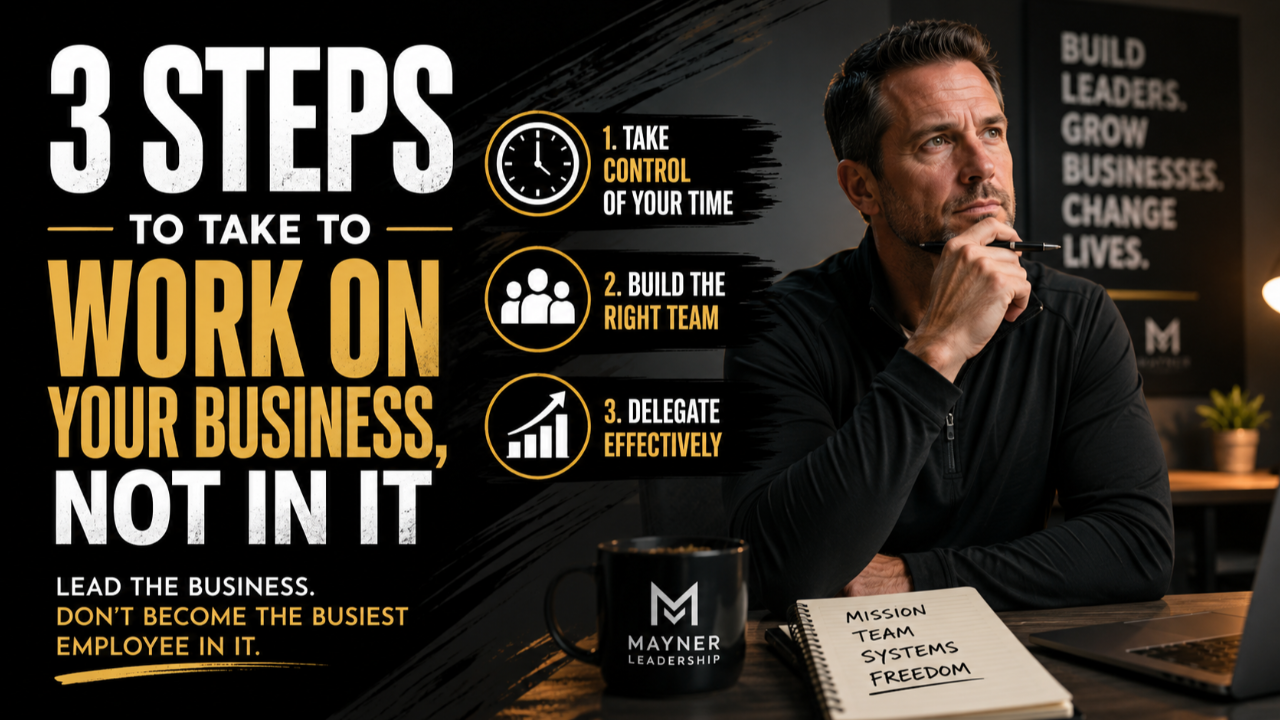
Lead the business. Don't become the busiest employee in it.
In This Article
- Take control of your time.
- Build the right team.
- Delegate effectively.
Key Takeaways
Take control of your time.
You can't lead strategically if you're constantly reacting. Audit your time, identify your highest priorities, and intentionally create space to focus on the work only you can do.
Build the right team.
The right people multiply your impact. The wrong people multiply your problems. Hire people who fit your mission, align with your values, and are willing to take ownership.
Delegate effectively.
Delegation isn't about getting work off your plate—it's about developing leaders. Clearly communicate expectations, provide the right tools, and empower your team to own the outcome.
Every small business starts the same way.
The owner does everything.
You answer the phone, make the sales, serve the customers, solve the problems, hire the employees, manage the finances, and somehow try to squeeze in time to grow the business.
In the beginning, that's normal.
The problem is many owners never make the transition from doing the work to leading the work.
Instead of building a business that grows beyond them, they become the busiest employee in their own company.
If every decision depends on you...
If every problem lands on your desk...
If your team waits for your approval before taking action...
You don't have a capacity problem.
You have a leadership problem.
Leadership isn't about working harder. It's about creating clarity, developing people, and building systems that allow your business to grow without depending on you for every decision.
That's what Absolute Accountability is all about.
Absolute Accountability means you own everything that affects the mission—every win, every loss, every problem and every solution. But owning everything doesn't mean doing everything.
One of the greatest paradoxes in leadership is this:
You are accountable for everything, but you cannot do everything.
To grow your business, you have to create leaders around you. That starts with these three steps.
1. Take Control of Your Time
If you don't control your calendar, someone else will.
One of the biggest mistakes I see business owners make is allowing urgency to dictate every day. They spend all of their time putting out fires instead of preventing them.
By the end of the week they're exhausted—but they haven't actually moved the business forward.
That's because they've been working in the business instead of on it.
One of the most important Leadership Laws is Prioritize & Execute.
You can't do everything.
But you must identify the most important things and execute them first.
Start With a Time Audit
You can't improve what you don't measure.
For one week, write down how you spend every hour of your workday.
Not how you planned to spend it.
How you actually spent it.
Track everything:
- Meetings
- Emails
- Phone calls
- Customer issues
- Employee questions
- Sales
- Administrative work
- Interruptions
- Problem-solving
Most owners are shocked by what they discover.
They realize they're spending their best hours on work someone else could be doing.
Or worse—they're spending most of their day reacting to problems that better communication, clearer expectations, or stronger systems would have prevented in the first place.
That requires humility.
The best leaders don't defend their habits.
They evaluate them.
Identify Your Highest-Value Work
Not every task creates the same value.
Some responsibilities only you can do.
Others simply require someone to do them.
Your job as the owner is to know the difference.
Ask yourself:
- What responsibilities truly require me?
- What creates the greatest impact on the business?
- What work gives me energy?
- What work consistently drains me?
- What could someone else own if I developed them?
If someone on your team can do a task at 80–90% of your level, it's probably time to start teaching them.
Otherwise, you'll remain the bottleneck.
Prioritize Before You Execute
One of the easiest ways to create clarity is by categorizing your work.
Think about every task in one of four buckets:
Important & Urgent
Problems that demand immediate attention.
Important but Not Urgent
Planning.
Leadership development.
Hiring.
Training.
Sales.
Process improvement.
These activities rarely feel urgent today, but they determine where your business will be six months from now.
Urgent but Less Important
Tasks that often interrupt your day but could eventually be delegated.
Neither Important nor Urgent
Distractions.
Low-value work.
Busy work.
Just because you're moving doesn't mean you're making progress.
One of my favorite reminders is simple:
Don't confuse motion with mission.
Use "First. Then. Next."
Complexity kills execution.
When everything feels important, nothing is.
Instead of overwhelming yourself with a massive to-do list, simply ask:
What's first?
Once that's finished...
What's next?
This simple habit creates momentum while eliminating decision fatigue.
Your team should operate the same way.
The clearer the priorities, the better the execution.
Build an Ideal Week
Your calendar should reflect your priorities—not your interruptions.
Schedule time every week for:
- Strategic planning
- Leadership development
- One-on-one coaching
- Business development
- Process improvement
- Financial review
- Personal growth
Protect this time.
If you don't intentionally create margin, your calendar will quickly become filled with everyone else's priorities.
Finally, begin every morning by identifying your Top Three Priorities.
Not ten.
Three.
These should be the activities that move the mission forward.
Discipline isn't about doing more.
It's about consistently doing what matters most.
When you lead your calendar instead of reacting to it, you'll finally create the space to work on your business instead of constantly surviving inside it.
2. Build the Right Team
Once you've taken control of your time, the next step is building a team that can carry more responsibility.
No business grows because one person works harder.
Businesses grow because leaders develop people who can lead alongside them.
One of the foundational laws in my leadership curriculum is Unite & Support.
Your job isn't simply to hire employees.
Your job is to build a team that works together, communicates well, supports one another, and remains focused on the mission.
The right people don't just reduce your workload.
They increase your organization's capacity.
Unfortunately, the opposite is also true.
The wrong hire creates confusion, frustration, rework, and unnecessary stress for everyone around them.
The right people don't just reduce your workload.
They increase your organization's capacity.
Unfortunately, the opposite is also true.
The wrong hire creates confusion, frustration, rework, and unnecessary stress for everyone around them.
Hire for Character Before Skill
Skills can be taught.
Character is much harder to develop.
Too many business owners hire because they're desperate to fill a position instead of disciplined enough to find the right person.
Don't just ask, "Can they do the job?"
Ask:
- Do they take ownership?
- Are they humble and coachable?
- Do they communicate well?
- Do they care about serving others?
- Will they strengthen our culture?
- Are they aligned with our mission and values?
You can teach someone how to perform a task.
It's much harder to teach someone humility, integrity, discipline, and accountability.
The best teams are built one great hire at a time.
Make Expectations Crystal Clear
One of my Leadership Laws is Inform, Update & Clarify.
People cannot execute what they do not understand.
When someone struggles, don't immediately assume it's a performance problem.
Ask yourself:
- Did we clearly explain the role?
- Did we define what success looks like?
- Did we provide the proper training?
- Did we answer the questions of Who, What, When, Where, Why, and How?
No understanding...
No execution.
One of the simplest tools every business should have is a Role Clarity Guide.
Every employee should know:
- Why their role exists.
- Their primary responsibilities.
- What winning looks like.
- How success will be measured.
- Who they support.
- Who supports them.
Clarity creates confidence.
Confidence creates ownership.
Ownership creates accountability.
Build Leaders, Not Followers
Too many owners unintentionally build teams that depend on them for every answer.
Instead, your goal should be to develop leaders at every level.
That doesn't mean everyone manages people.
It means everyone owns their responsibilities.
Everyone communicates.
Everyone solves problems.
Everyone contributes to improving the mission.
That's what Distribute & Empower looks like.
When your team grows, your business grows.
3. Delegate Effectively
Delegation is where many businesses either accelerate—or stall.
Most owners know they need to delegate.
The problem is they either delegate too little or they delegate poorly.
Some refuse to let go because they believe no one can do it as well as they can.
Others hand work to someone with little direction and hope it somehow gets done correctly.
Neither approach develops leaders.
Effective delegation requires both accountability and empowerment.
Remember one of the greatest leadership paradoxes:
You own everything, but you cannot do everything.
The goal isn't to remove yourself from responsibility.
The goal is to multiply your leadership through other people.
Delegate Outcomes, Not Just Tasks
Don't simply tell someone what to do.
Explain what success looks like.
Every delegation conversation should answer six questions:
- What needs to be accomplished?
- Why does it matter?
- What does success look like?
- When is it due?
- What authority do they have?
- How will we communicate progress?
When people understand the outcome—not just the task—they make better decisions.
They begin thinking like leaders instead of simply following instructions.
Teach. Train. Equip. Empower.
Delegation is not dumping work onto someone else's plate.
It's investing in their growth.
Slow down enough to teach them properly.
Give them the tools.
Provide resources.
Practice together.
Answer questions.
Observe their performance.
Provide feedback.
Then gradually give them more ownership.
One of the biggest mistakes leaders make is expecting people to perform work they've never been taught how to do.
Accountability without training creates frustration.
Training without accountability creates inconsistency.
You need both.
Use Readbacks
One of the simplest communication tools I teach leaders is the Readback.
After giving direction, ask the person to explain the plan back to you in their own words.
Not because you don't trust them.
Because you want to eliminate misunderstandings before they become expensive mistakes.
A Readback confirms:
- The objective.
- The priorities.
- The deadline.
- The expected standard.
- The next steps.
It's one of the fastest ways to improve execution.
Coach, Don't Micromanage
Delegation doesn't end once the assignment has been handed off.
Your job shifts from doing the work to coaching the work.
There's a big difference.
Micromanagers control every decision.
Coaches develop better decision-makers.
Set regular check-ins.
Give honest feedback.
Celebrate progress.
Correct mistakes quickly.
Continue asking questions instead of immediately giving answers.
The goal is to help people think for themselves.
That's how ownership develops.
That's how confidence grows.
That's how future leaders are created.
Debrief Everything
Every project creates an opportunity to improve.
Don't simply finish the work and move on.
Debrief it.
Ask questions like:
- What went well?
- What didn't?
- What did we learn?
- What should we repeat?
- What should we improve next time?
One of my Leadership Laws is Innovate & Adapt.
The mission never changes.
But your strategy should constantly improve.
Great organizations don't become successful because they avoid mistakes.
They become successful because they learn from them faster than everyone else.
What's Next?
Most owners believe business growth comes from working harder.
It doesn't.
Growth comes from becoming a better leader.
The more your business depends on you personally, the harder it becomes to scale.
The more you develop leaders around you, the more capacity your business gains.
If you want to work on your business instead of constantly in it, focus on these three steps:
- Take control of your time.
- Build the right team.
- Delegate effectively.
None of these are complicated.
But all of them require intentional leadership.
They require humility to recognize where you're the bottleneck.
Discipline to focus on what matters most.
Conviction to protect the mission.
Awareness to recognize what needs to change.
And the courage to trust and develop the people around you.
At the end of the day, leadership isn't about being the person who does the most work.
It's about building a team that can accomplish the mission together.
That's what Absolute Accountability looks like.
You own the mission.
You develop the people.
You empower the team.
And instead of becoming trapped inside the business, you finally create the freedom—and the leadership capacity—to move it forward.
Get the Newsletter
Want Tactical Business and Leadership Tips sent to your inbox every week? We've got a newsletter just for you
We hate SPAM. We will never sell your information, for any reason.